
Is the demo scene dead or does it just smell that way?
category: general [glöplog]
grip said:
Yeah and this is hitting, I think, a point affecting the whole scene.
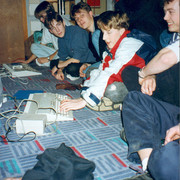
Basically the party crowd does not look like this anymore:
(credit: slim/equinox)
That is Lonestarr/Spaceballs at The Party 1992 surrounded by other legendary sceners. He won that compo with the demoscene-defining State of the Art, AFAIK while still a (very very young) teenager.
Now, major parties are attended by people on average well over 30 and compowinners are almost exclusively 40+ (at least in the old school categories).
Well, personally, I love love love what Cahir/Ghostown did. He made a demoscene course while working at Univesity of Wroclaw, Poland that netted 3 new college-aged Amiga coders all of them collaborating on compowinning prods (Amiga 500 prods)
I also personally know of 2 demosceners whose teenage kids are participating.
Is that enough? Should there be more? Is it all for nothing? I do not know.
Will demoscene events ever look remotely like they did in early 1990s? I do not think so.
Will the scene die off in a decade or so? Maybe, maybe not. Will 1980s platforms be relevant in the demoscene 10 years from now? I don't know.
But it's UNESCO recognized cultural heritage in Sweden, France, Germany, Finland, so maybe it means something and maybe it will carry over for centuries... who knows?
It remains in my opinion one of the most exciting ways of mastering a complex technology and media constraints inside out while keeping teams very small, passions high and motivations as truly non-profit as they can be.
Quote:
Revival, however, isn't the same as rejuvenation.
Yeah and this is hitting, I think, a point affecting the whole scene.
Basically the party crowd does not look like this anymore:
(credit: slim/equinox)
That is Lonestarr/Spaceballs at The Party 1992 surrounded by other legendary sceners. He won that compo with the demoscene-defining State of the Art, AFAIK while still a (very very young) teenager.
Now, major parties are attended by people on average well over 30 and compowinners are almost exclusively 40+ (at least in the old school categories).
Well, personally, I love love love what Cahir/Ghostown did. He made a demoscene course while working at Univesity of Wroclaw, Poland that netted 3 new college-aged Amiga coders all of them collaborating on compowinning prods (Amiga 500 prods)
I also personally know of 2 demosceners whose teenage kids are participating.
Is that enough? Should there be more? Is it all for nothing? I do not know.
Will demoscene events ever look remotely like they did in early 1990s? I do not think so.
Will the scene die off in a decade or so? Maybe, maybe not. Will 1980s platforms be relevant in the demoscene 10 years from now? I don't know.
But it's UNESCO recognized cultural heritage in Sweden, France, Germany, Finland, so maybe it means something and maybe it will carry over for centuries... who knows?
It remains in my opinion one of the most exciting ways of mastering a complex technology and media constraints inside out while keeping teams very small, passions high and motivations as truly non-profit as they can be.

Many public events will never look like they did in the 90s-2000s, with many entertainment fields moving online and separating into their own bubbles. Not to mention being public about your activities is unsafe and/or quite expensive.
Still, there's lots of young folks nowadays are making game mods, romhacks, fangames, animations and stuff. Unless we tell them where we are, what we can do and what THEY can do with what we know and have, that's where they'll aggregate.
Still, there's lots of young folks nowadays are making game mods, romhacks, fangames, animations and stuff. Unless we tell them where we are, what we can do and what THEY can do with what we know and have, that's where they'll aggregate.

For sure it dying, is only us that cares about this ... But we (hope for most) have another 20++- years or so to still enjoy the classic machines/technical interest together with parties and fun .... Even if in only do ascii stuff here and there i alays got Amigas running and watch the latest productions and it`s much quality and skills involved, so much cool stuff and cool peoplez still around ...
Btw: I`m talking about the Amiga freaks that are indeed age 40+ now.. I was always the youngest at demoscene (and Amiga in general) events around here and i am 44 now. N
Nobody else cares about our machine and that`s fine, trying to interest the younger guys and our kids to this hobby is almost impossible .. They do their own thing, as we do ours :)
Btw: I`m talking about the Amiga freaks that are indeed age 40+ now.. I was always the youngest at demoscene (and Amiga in general) events around here and i am 44 now. N
Nobody else cares about our machine and that`s fine, trying to interest the younger guys and our kids to this hobby is almost impossible .. They do their own thing, as we do ours :)

Myo is right here. It’s little bubbles online; scenes are a thing of the past (until it all come back, who knows, in a decade or so following a post-ai diaspora)
Lots of young people talk about old trackers and videogame music or chiptune as well online. Tons of other into pixel art, emulations or look at live coding and other interests… but the goal is not to join a scene to find a group, coexist, and collaborate (and listen). The goal for them is visibility, content, attention.
A scene generally tries to aggressively gatekeep against people who don’t engage with others; and when wolves manage to infiltrate, they can destroy it from within.
Lots of young people talk about old trackers and videogame music or chiptune as well online. Tons of other into pixel art, emulations or look at live coding and other interests… but the goal is not to join a scene to find a group, coexist, and collaborate (and listen). The goal for them is visibility, content, attention.
A scene generally tries to aggressively gatekeep against people who don’t engage with others; and when wolves manage to infiltrate, they can destroy it from within.

Quote:
scenes are a thing of the past
Scene is well alive. What's the point with this endless self-flagellation? Are you some kind of hardcore fundamentalist christians?
Quote:
A scene generally tries to aggressively gatekeep against people who don’t engage with others
I've always done my sceneing all by myself and I've never felt anything like this. No any problems.

riiiiiiiiiiiiiiiiiiiiiiiiIIIIIIIIIIIIght.
> but the goal is not to join a scene to find a group, coexist, and collaborate
> (...)when wolves manage to infiltrate, they can destroy it from within.
The demo scene of days long gone was elitist, tribalist and pretty mean spirited. But today we're older, (hopefully) wiser and do it for the fun. So today, we want to have a community going. You spell it out like we should not trust the newcomers. I hope I'm understanding you right here. But I beg to differ. All communities may occasionally attract rotten eggs, but that's exception, not the rule.
Shutting out the younger generations because they're "wolves" is not the right answer. The door should be open.
If you want an enemy, let me give you one: artifical intelligence.
I have no problems with demo sceners using AI in their work as long as it's not directly creating content they compete with. AI to help you build a nice website, documentation or help the orgas organize is fine, imo. But it should never create assets for demos and compositions.
The demos are by humans for humans...
Let me just step down from my soap box.. Thanks.
> (...)when wolves manage to infiltrate, they can destroy it from within.
The demo scene of days long gone was elitist, tribalist and pretty mean spirited. But today we're older, (hopefully) wiser and do it for the fun. So today, we want to have a community going. You spell it out like we should not trust the newcomers. I hope I'm understanding you right here. But I beg to differ. All communities may occasionally attract rotten eggs, but that's exception, not the rule.
Shutting out the younger generations because they're "wolves" is not the right answer. The door should be open.
If you want an enemy, let me give you one: artifical intelligence.
I have no problems with demo sceners using AI in their work as long as it's not directly creating content they compete with. AI to help you build a nice website, documentation or help the orgas organize is fine, imo. But it should never create assets for demos and compositions.
The demos are by humans for humans...
Let me just step down from my soap box.. Thanks.

Back when we were kids, we were all about unlocking the full potential of our brand-new computers, using machines that were the best of the best at the time.
Now, looking back, to expect the new generation might be using old computers instead of what’s available today, which is just a bit of extreme wishful thinking. It won’t happen. If there are new sceners, they’ll mostly be on PCs or other high-end machines.
Think about cassette tapes. We won’t be using them to listen to music either. but they are retro as well.
Personally, I introduced my daughter to the demoscene because I saw that we share the same creativity and passion for creating art. But I wouldn’t tell her to stick to Pixel Art if she can achieve more with modern tools.
Now, looking back, to expect the new generation might be using old computers instead of what’s available today, which is just a bit of extreme wishful thinking. It won’t happen. If there are new sceners, they’ll mostly be on PCs or other high-end machines.
Think about cassette tapes. We won’t be using them to listen to music either. but they are retro as well.
Personally, I introduced my daughter to the demoscene because I saw that we share the same creativity and passion for creating art. But I wouldn’t tell her to stick to Pixel Art if she can achieve more with modern tools.

reading comprehension much
Quote:
But I wouldn’t tell her to stick to Pixel Art if she can achieve more with modern tools.
I don’t really understand wha do you mean meant by “modern tools” and “achieve more”.
There are “modern tools” for pixel art. In fact all pixel art that gets churned out these days, in and out of the scene is made with “modern tools”. Almost all code likewise. Hats off and an apology to those who still produce pixel art with a joystick on a C64 in Koalapainter, and save their work out to a floppy if they exist. That would be downrifght bifat level of dogma pixelling.
Perhaps this could help clarify: Do you think writers will/would “achieve more” with “modern tools”?

Quote:
This is a bit off topic, but interesting nonetheless. Most authors probably wouldn't give up their word processing software and go back to quills and inkwells (in fact, both can still be acquired). Writing, like many creative pursuits, is an iterative process. A word processor is extremely helpful with that.Do you think writers will/would “achieve more” with “modern tools”?
As someone who dabbles in both visual art and a bit of amateur writing, I'm not sure this is a good comparison. Nobody really cares if an author is a master of calligraphy: the end result of writing is a body of text, presumably published online or in print. That means someone else is in charge of how the letters are presented.
When it comes to visual art, the tools and medium have a much larger impact on the end result. You can achieve certain things with oil on canvas that can't be reproduced on a 16-bit home computer, and vice versa. This is also why we view paintings in museums and covet old CRT screens. The same is true of modern digital painting compared to pixel art, which is presumably why Amiga demo graphics today often display machine dithering and other signs of image downsampling.
Creating art should be a joyful experience. Personally, I don't accomplish much at all if the tools feel forced.

grip said:
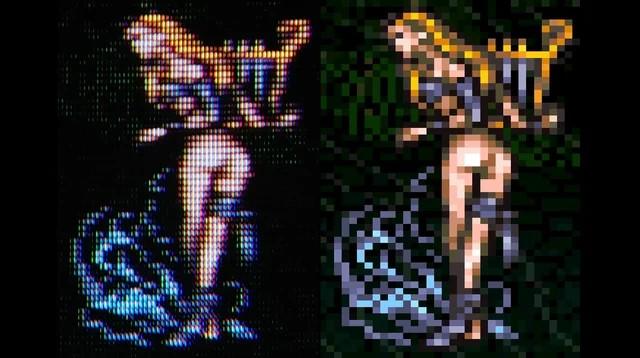
It took a month, but so worth it to revive this 1084S, exactly for this reason:

I wanted the picture on the left, as opposed to the picture on the right:
Quote:
This is also why we view paintings in museums and covet old CRT screens.
It took a month, but so worth it to revive this 1084S, exactly for this reason:
I wanted the picture on the left, as opposed to the picture on the right:
Quote:
Creating art should be a joyful experience. Personally, I don't accomplish much at all if the tools feel forced.
Indeed.
I was thinking of chatgpt and such as a “modern tool” for writers. Word processors are a great help to writers. Although they don’t really affect quality IMHO, they just streamline writing somewhat, make it more convenient for iterating, speed up the process. I’m saying this because there are (very limited) all-or-nothing people claiming that LLMs are a natural extension of technology, and folks should either write with sticks in the sand or embrace LLMs.
please keep your AI discussions where the sun don't shine

Understood.
Please stop stalking me.
Please stop stalking me.
it's not stalking when it's a ~50% chance you are the person who yet again wiggles AI in an otherwise interesting discussion
Understood.
Please stop stalking me and spamming the thread.
Please stop stalking me and spamming the thread.
Nope - demoscene is far from being dead, doesn't even smell a bit like that :)

Quote:
Nobody else cares about our machine and that`s fine, trying to interest the younger guys and our kids to this hobby is almost impossible .. They do their own thing, as we do ours :)
This is really funny to hear because my post showed the opposite: young people are interested in technical stuff for old computers, just about as many people were interested in programming in the 90s. Don't tell me it wasn't kind of niche back then either, because many more people back then were "interested in the scene" mainly to leech games.
However, there are a bunch of economic and social factors that push these 'potential sceners' away from the Amiga scene in particular. It's difficult to fight with economics, but social factors are everyone's responsibility here. Which is why I find it "funny" to see my post got basically ignored.

Quote:
This is really funny to hear because my post showed the opposite: young people are interested in technical stuff for old computers, just about as many people were interested in programming in the 90s. Don't tell me it wasn't kind of niche back then either, because many more people back then were "interested in the scene" mainly to leech games.
I think most people here strongly assume that programming indeed was a more popular hobby in the 1990s. I don't have an academic source for this though (does somebody have?). But for instance the initial motivation behind the development of the first Raspberry Pi computer (2012) was that young people were not so much into program anymore and the skills of new CS students were perceived getting lower and then it was thought that we should supply some cheap computers for them to remove this obstacle.
However, what is relevant here is that there still are many young people who are interested in programming.
Quote:
However, there are a bunch of economic and social factors that push these 'potential sceners' away from the Amiga scene in particular. It's difficult to fight with economics, but social factors are everyone's responsibility here. Which is why I find it "funny" to see my post got basically ignored.
Demos for oldskool platforms are mostly done with emulators by using machines of today so I don't think purity culture exists in this sense. But it's true that especially Amiga people would complain at least here in Pouët if a release didn't work on a real machine. However, I'm pretty sure they would accept the explanation if they were informed that a creator is a young person who couldn't afford Amiga. I remember some time ago a scener gave an Amiga without charge to a bit younger guy who was interested in tinkering with one.
But if this kind of barriers exist, then it would be probably worth of pondering what we can do to lower them.
Quote:
I'm sorry if this sounds a bit harsh, but I found your post to mostly be a list of grievances that aren't really the fault of "the scene", and didn't bother replying initially. Let me try to address your points, if you'll allow me the liberty to paraphrase:Which is why I find it "funny" to see my post got basically ignored.
> Amiga hardware is too expensive.
Alas, elder sceners may seem powerful, but not even they can change the whims of the second hand hardware market.
> FS-UAE isn't good enough.
AFAIK, WinUAE runs under Wine. Another area where elder sceners, unfortunately, don't have any more power than anyone else.
> Linux has bad tooling.
So you wrote your own. Kudos.
> Kids prefer consoles.
Being interested in old hardware isn't the same as being interested in the scene. Looking through the sparse SNES and Genesis releases from the last few years, most seem to be made by old-timers. I see two NDS releases during the last two years here on pouët. One is by you, and a nice one at that. Kudos again.
> Demo parties are far away and/or expensive.
There's no central licensing authority for demo parties. You can organize your own, even if it's just ten guys at a local community center. Plus, plenty of parties accept remote entries which means you can still get your releases out there.
> There's a purity culture.
This is a bit ironic, considering the theme of your own NDS demo :) In any case, I don't think bifat's tongue-in-cheek thread is much proof of anything, since he's actually also a big proponent of AI tools. I personally prefer working on real hardware because it makes me feel all warm and fuzzy inside, but tooling is just that: personal preference. Almost all Amiga sceners I know use modern stuff in some form or another for their productions. When I watch easily accessible Amiga demodev content, like h0ffman's youtube channel, I see VSCode, emulators and online tools like Coppenheimer in use. The point of it all is of course that the end result should run on real hardware, otherwise it's a rather futile exercise.
The scene is about doing stuff yourself, overcoming obstacles and being creative with limited resources. Surely twenty-somethings who are into Linux and open source emulator development can relate to that? All they have to do to partake, should they so desire, is to release something. If they don't, that's fine. What I'm not going to do is barge in on their turf like some out of touch boomer and start yelling at clouds about how the scene is where it's at. I don't think that would be appreciated, but I might be wrong.
> Don't tell me it wasn't kind of niche back then either.
The scene has always been niche. It was slightly less niche in the 80s/90s, though. The two most popular home computer magazines in Sweden, for example, featured regular scene content (party reports, demo reviews) and had a lot of features about assembler programming, even specifically about demo coding. Even big English-language mags like Amiga Format acknowledged the scene and published regular round-up reviews of demos. The biggest parties attracted thousands of attendants several times per year, and teenagers hauled bulky CRT monitors and Amigas all across Europe to visit them.
Apart from gaming and writing the odd school essay, there really wasn't much point in having a home computer if you weren't into coding, graphics, music or swapping - they weren't appliances for watching Tiktok, if you catch my drift. If venturing a guess, I'd say more computer users per capita were more than just passive consumers back then, and if you were a teenager into creative computer stuff in Europe, you'd probably heard about the scene even if you weren't actively involved.
Quote:
In any case, I don't think bifat's tongue-in-cheek thread is much proof of anything, since he's actually also a big proponent of AI tools.
t's not entirely tongue-in-cheek. What I'm doing would be way too much work for just poking fun at some AI hating mob, which will fade into insignificance anyway. This is more a collateral effect.
Proponent of AI tools, hmm... not really. They have problems, you need to put quite some effort into it to get them under your control. There's a world of a difference between pro something and not being contra something. I'm a proponent of giving them a try. Any serious, self-respecting nerd, artist, and demoscener would do that, I would guess. Or better come up with some dogmas which can be taken seriously :)

Hereby I’m summoning Maali, the fierce AI watchdog upon you! He will surely react to your heresy, because it’s not like he’s stalking only me in particular.
Yeah lol fuck AI.

Yeah lol fuck AI.